Posts Tagged friends
Dorothy and the Oz of New Hampshire
[This is a continuation of the last bit of past history.]
Before I moved into Dorothy’s Germantown garret, Dorothy and Tom had bought a chunk of land near Keane, New Hampshire. They were planning to build a house and move there. As they prepared to travel up during my first Germantown summer, they left an open invitation for me to visit.
Thank god! I was falling apart and needed to get away, fast. I didn’t have a car now – the VW was at Julie’s (its rejuvenation following my drunken accident deserves its own sad story) – but I could take a bus.
The bigger trouble was that I was too rattled mentally to plan ahead. On the date I had muddily fixed for departure, I had made no arrangements with Dorothy, and she had no phone. As I waited for Julie to pick up Morgan and Erin, I was a shimmer of jitters and shakes, barely able to hold a conversation. God, what a thing to do to my children.
The bus would drop me off in Brattleboro, VT, about which I knew zilch. How was I to get to Dorothy’s, across whatever river and down whichever highway in NH? I had some vague idea of hitchhiking and walking. I’d hitched only a couple times in my life and was (am) not comfortable dealing with strangers to whom I owe even incidental favors.
Dorothy had hinted at harboring some minor psychic ability – probably more a well-functioning intuition. Without any advance notice from me, when the bus pulled up in Brattleboro, there she was, with her son, Rusty. She just had an idea that I was going to be on that bus, that day. If she hadn’t, I’d probably still be wandering the backwoods of New England, escaping from Stephen King.
Rusty, in his late 20s or early 30s, was a cowfucker, a noble and necessary profession. He carried phials of bull semen, set in a canister of liquid nitrogen, from farm to farm to inseminate cows. Cowfucker was the informal term in the trade. People tended to be leery around him when he rode public transportation. A woman would sit next to him, read “bull semen” on his container and shift to another seat.
Dorothy and Tom’s land held no permanent structure beyond the beginnings of a cinderblock foundation. They (and I) lived in tents. The bathroom facilities consisted of a wooden box with a round cutout, set on a hillside, seated over a pit. It had no roof. On rainy days you crapped wile holding an umbrella.
Tom (Dorothy’s second husband, not the father of Becky or Rusty) was an odd duck. Outwardly jovial, he held a deep-seated cynicism about the human race, both in its wider manifestations and as individuals. That first year, we got along famously, and my stay in NH was the highpoint of that dreary, bedraggled year.
A few months after our return to Germantown, something changed. Earlier, Tom had turned against a former friend; now he seemed to be doing the same with me. Jealousy at my friendship with Dorothy? I had no idea, but I could sense the seeping coldness.
One day I went out and neglected to lock the back door of the house, which led to its large, brick-wall-enclosed yard. Both Tom and Dorothy were more upset than I could quite understand. When I accidentally repeated my transgression – because I was certain they were in the house when I left – they stood on the stairs and lectured me like a schoolboy.
As the second summer approached, Dorothy told me they wanted to “see what it would be like to live alone.” In less euphemistic terms, I was being kicked out.
Dorothy and I held a final, tearful evening upstairs, almost as riotously drunk as the night following our infamous duck dinner. At one point, she recounted a strange story: A woman who had been her close friend told her, without preamble, “I can’t be your friend anymore.”
Dorothy said she never understood, never uncovered the rationale. But I think, consciously or not, she was telling me something about herself and me. A friendship that I had come to accept in a simplistic way just … wasn’t anymore. Like her, I never understood, never identified the “why.”
A few years ago, Erin sent me an email address for Dorothy, still in NH but with a different last name. We corresponded a couple times, very cordial. She was having an eye problem – the usual old-fart stuff.
A year later I tried the address and it was gone. I don’t know what’s become of someone who, for awhile, was the beacon in my life.
The year of ducks and gizzards
Novels, dramas, and (especially) TV scripts lay claim to defining incidents in life that color all that follows. Could be, I suppose, for those whose brains are set with trigger wires, but I’ve had no defining incidents. So, though the particular period I’m outlining here holds an emotional crumbling edifice, to me it’s just something more to be looked at.
By 1975, my marriage to Julie having dissolved into a pudding, I moved from Hamilton St. in Philly’s Powelton Village to the stone colonial rowhouse of my friend Dorothy on Germantown Ave. (the house across the street still bore bullet scars from the Revolutionary War).
Dorothy was the music teacher at Miquon – Morgan and Erin’s fabulous school – a short, stocky, quietly engaging, wholly wonderful woman of Finnish descent who approached music as though invented specifically to instruct kids and make them deliriously happy. For the first couple years that I was doing the maintenance at Miquon, the school also had a drama teacher. When she left, Dorothy merged music and stage using mostly original material.
While at Dorothy’s Germantown house – which also sheltered her husband, Tom, and teenage daughter Becky – I was living on $13 a week in a magnificent garret: two rooms and a large bath, the whole floored with 18″ pine boards cut from trees you’ll never again see flourish in Pennsylvania. The building (the end one of the row), rearing flat-fronted and unapologetic above the sidewalk, was set on a one-third acre lot that stretched back along a side street, behind a high stone wall.
Mice scurried under the sink and I had to reseat the oozing toilet, but in compensation there were sloped true-plaster ceilings, a huge space comprising kitchen and living room, soaring sunlight, and access to the bathroom window from the porch roof (as I found later when I’d looked myself out).
One aural drawback to Germantown Ave.: It had been drawn originally as the only uninterrupted local thoroughfare. In our modern age, that makes it the premier route for emergency vehicles. Those colonial houses, lined cheek by jowl, turn it into a reverberation chamber that drove me half crazy with a constant blitz of fire engine and ambulance sirens at high screech.
Morgan and Erin stayed with me roughly half time in the easygoing shared custody that Julie and I had worked out. (Easygoing for us two, though it must at times have been hell for the kids.)
The highpoint of the days when they weren’t with me was watching the six o’clock local news presented by Jessica Savitch. Savitch was the most absurdly scrumptious woman ever to deliver TV’s urban banalities, and I’d sit there, drooling. (She went on to better things nationally before drowning in a car wreck in the Delaware Canal. It’s sobering to think of this vibrant sensuality in a coffin somewhere, slowly turning to dirt.)
But most important, there were Dorothy and Becky. Dorothy and I had bonded in a straightforward, non-romantic way, sitting and talking for hours, drinking far too much and enjoying every drop. I spent much of the time alone, but Becky would come up on Sunday evenings to listen to Gene Shay’s folk music program, then on WXPN. She was blonde, with a haunting, sharp-planed face chiseled from stone. She was also a funny, straightforward presence. I treasured those evenings.
One year, Dorothy and I hatched a plot for the Miquon teachers and staff to enact a surprise Halloween play for the kids. We chose a repetitive folktale, “Soap, Soap, Soap,” expanding on it to give every staffer a part. We socked the kids good with that one – they didn’t suspect a thing. That established a tradition of staff goofiness that, I sincerely hope, may still flourish.
Each work-day morning, about 20 minutes before it was time for me to leave for Miquon, I’d call one or another of the teachers who lived nearby (the Germantown area was a hotbed of Miquonites) to ask for a ride. I never established a begging schedule, never thought to establish a schedule. Instead, I started each day with a separate, individual cup-in-hand humiliation. (Ah, the lacunae in our flourishing mental aptitude.)
After my part-tine work, about 4 pm, with no one else home, I would go down to that expansive yard and whack a whiffle ball back and forth. It gave me something to do to keep blackness at bay. On the days when Morgan and Erin were with me, I would take care of them in some disorganized way. They were saved less by me than by the yard, our St. Bernard, Pearl (the Best of All Possible Dogs), and the good graces of Dorothy.
Why was I living on $13 a week?
Shortly before I moved to Germantown, while my marriage was already slipping into absurdity, I made plans to spend my birthday evening at Dorothy’s. But when I stopped by “home” that day, Julie was cooking me a duck for dinner.
It had never occurred to me that she would want to celebrate anything with me. I felt gut-punched. I told her my tentative plans with Dorothy. Julie opened the oven and insisted that I take the duck with me. There was no decision I could possibly choose that would make this situation even vaguely tolerable. I froze, dillied… and took the duck to Dorothy’s, the blackness deep as a mine.
That’s when Dorothy and I (where was Tom? working? Becky? Studying?) consumed a quart and a half of black Russians (Kahlua and vodka). I could barely see as I started the drive back to Hamilton St. Two blocks along, I whacked the VW bus against somebody’s parked tailfin. I stopped and stood dutifully in the middle of the street, waiting for retribution. With my inexcusable luck, none appeared. Instead, a cop wrote down the details but never tested me for alcohol. Yet, I must have stunk like a skunk.
The VW was a crippled horse de combat, the passenger door folded like a swan’s wing and sticking out in the breeze,. But it took me “home,” good, indulgent beast.
At the threat of having my driver’s license revoked, I agreed to pay $25 a month to cover the car-owner’s damages. That left me, on average, $13 a week for food and all of life’s joyous extravagances.
(The drinking bout also bestowed a two-day hangover, during which, at Miquon, I had to use a chainsaw – for the first time in my life – to dismember a huge willow that had fallen across the main play area. Head throbbing, knees shaking, I wobbled along the trunk, trying to make the torturously loud machine obey my confused commands. That I still have two legs is close to a miracle.)
Across the side alley by Dorothy’s sat a Korean-owned food market that catered to the down-and-out local trade with stuff like chicken gizzards at $.33 a lb. I ate a lot of chicken gizzards those days. I also tried hog maws once. Don’t.
The $13 supplied not just food, but the occasional commuter-train run to Miquon when rides where unavailable, and my one extravagance: lunch every Friday at the Maharaja Indian restaurant near Penn. We each have something too important to release, whatever the cost or circumstances.
At Dorothy’s, I put myself through a disciple I’ve never since matched. I sat at my typewriter each day and forced myself, no matter how black the blackness, to add three pages to the novel I’d started the year before – a meandering bumble with two independent plotlines that would meet, obliquely, only at the final chapter.
The chapter headings were three-letter abbreviations for the amino acids that formed the two chains of pig insulin, the first protein to have its structure accurately described. Those two chains, together, held the exact number of amino acids as my novel had chapters. Sheer, unlikely chance. Again.
Looked at later, all those pages formed one bodacious, absurd piece of shit. Now and then I pull up one of the “better” pieces and check it out, usually while scratching some obscure bodily itch.
And you know, I treasure those bits. Life is bits and pieces. When all seems impossible or evil, we should choose the best bits and cast the rest to internal Hades.
Clearing out the crap
Posted by dsbdavis in Linda, Uncategorized on December 15, 2012
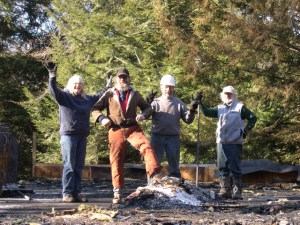
Hail the conquering heroes! After a week of work, the 2nd floor walls are down, and we’re ready to put the tarp over the floor to protect the wood shop on the first floor!
Thank you friends!
 lickhaven